
Powerful Single Board Computer ODROID-H3


Powerful Single Board Computer ODROID-H3
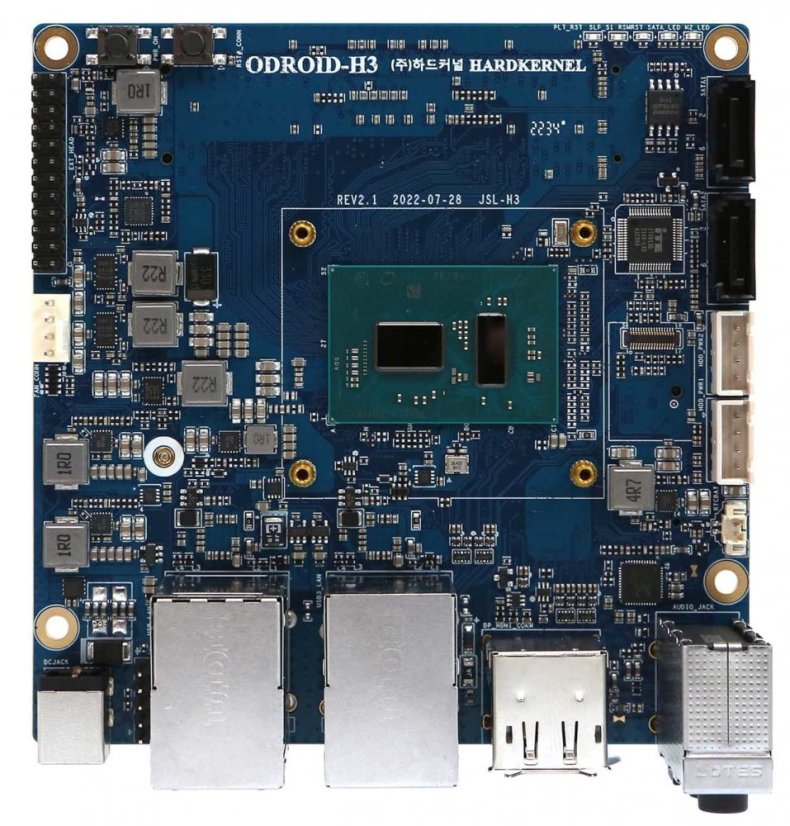
ODROID-H3
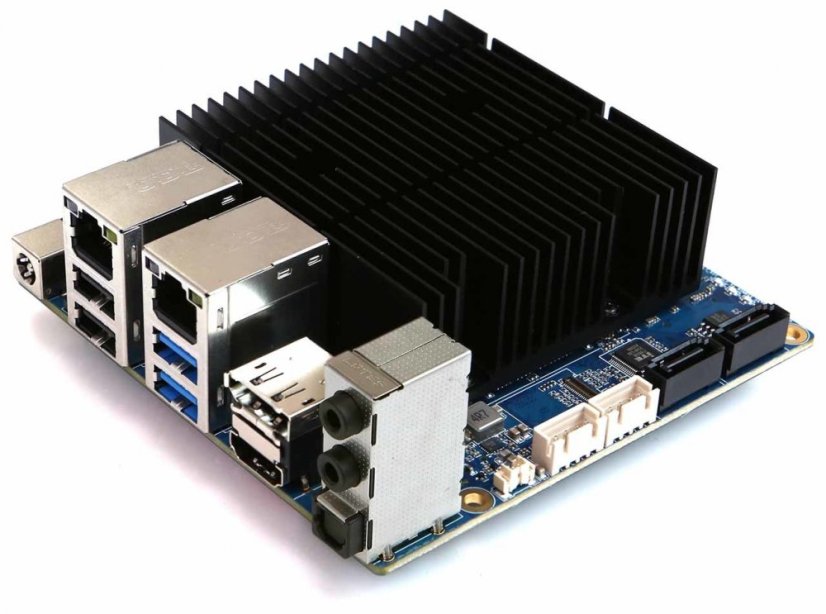
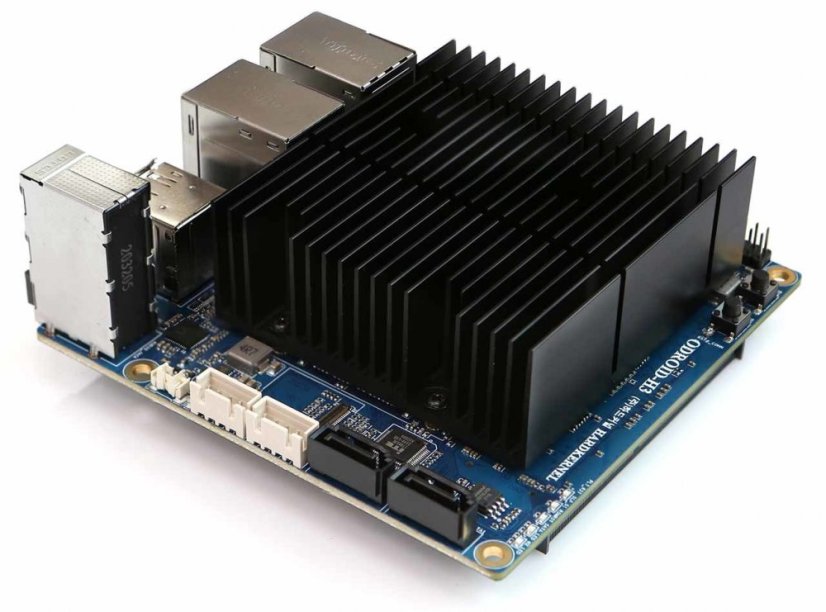
The ODROID-H3 features the same form factor and similar energy efficiency as its predecessor, the ODROID-H2+, but it is more powerful and offers greater performance.
This all-new 64-bit single board computer x86 boasts excellent compatibility with large memory capacity and advanced IO ports.
The quad-core Intel® Jasper Lake N5105 processor has a base clock speed of 2 GHz and a boost clock speed of 2.9 GHz, with 1.5 MB L2 and 4 MB L3 cache using a 10 nm process.
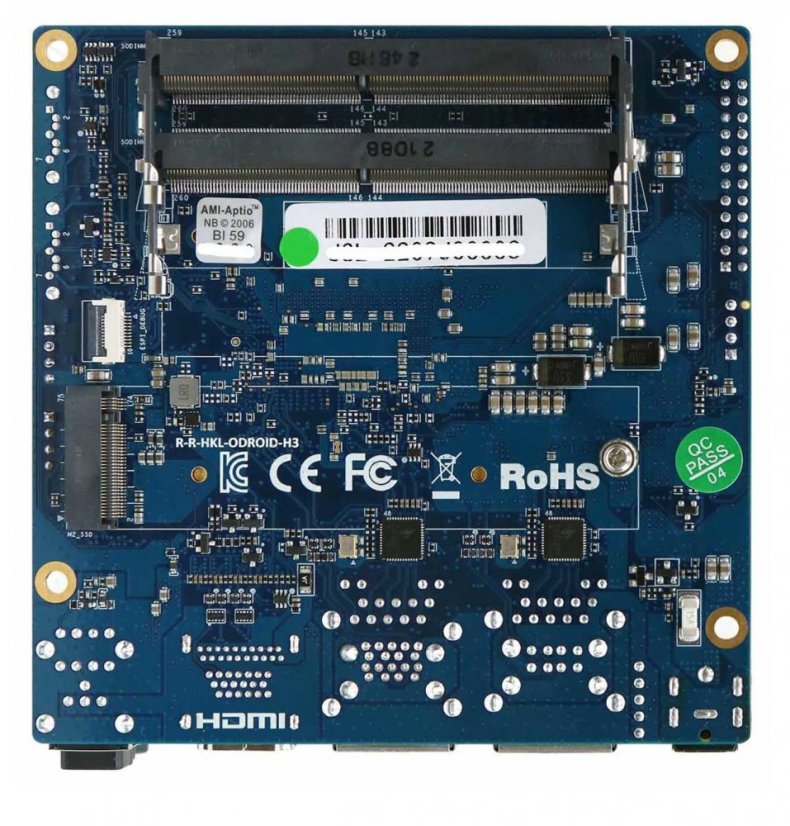
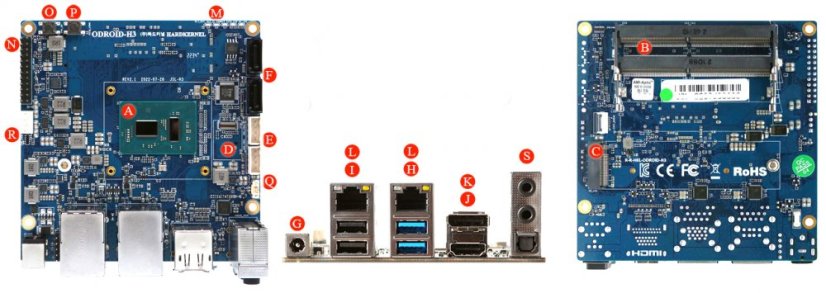
- Up to 64 GB dual-channel DDR4 PC4-23400 memory (2933 MT/s)
- Two SO-DIMM slots, up to 32 GB per slot
- PCIe 3.0 x 4 slots for one M.2 NVMe storage
- 2 x 2.5 Gbit Ethernet ports
- 2 x SATA 3.0 ports
- SSE4.2 accelerator (SMM, FPU, NX, MMX, SSE, SSE2, SSE3, SSSE3, SSE4.1, SSE4.2, AES)
- Intel UHD Graphics 24 EUs Turbo 800 MHz (H3+: 900 MHz)
- Multiple video outputs HDMI 2.0 and DP 1.2
- Configurable unlimited performance mode allowing the CPU to operate in permanent turbo boost mode.
- RTC/BIOS backup battery included

|
|
Specifications:
| Processor | Intel Celeron N5105(H3+: N6005) Processor (10nm, Quad-Core, TDP 10W)
H3(N5105): up to 2.9 GHzH3+(N6005): up to 3.3 GHz 4MB L2 Cache Intel UHD Graphics (24/32 EU up to 900MHz) |
| Memory | 2 x DDR4 1.2V SO-DIMM slots
Dual-channel, up to 2933 MT/s (DDR4-PC23400) Maximum memory capacity 64GB DDR3/DDR5 are not supported |
| Storage | 1 x eMMC connector (bootable and optionally for BIOS)
Various eMMC modules can be purchased from the Hardkernel store 2 x SATA3 6Gbps 1 x M.2 slot (PCIe 3.0 x 4, supports NGFF-2280 cards) M.2 SATA SSD not supported |
| Networking | 2 x GbE LAN ports (RJ45, support 10/100/1000/2500 Mbps)
Realtek RTL8125B Supports Wake-On-Lan LED indicators (Green: Link, Amber: Traffic) |
| Video | 1 x DisplayPort 1.2 (up to 4K@60Hz)
1 x HDMI 2.0 (up to 4K@60Hz) Supports dual simultaneous display |
| Audio | 1 x Audio out (3.5mm jack)
1 x Audio in (3.5mm jack) 1 x SPDIF out (ALC1200, HDA codec) * HDMI & DP also have audio output. |
| External I/O | 2 x USB 3.0 Host ports
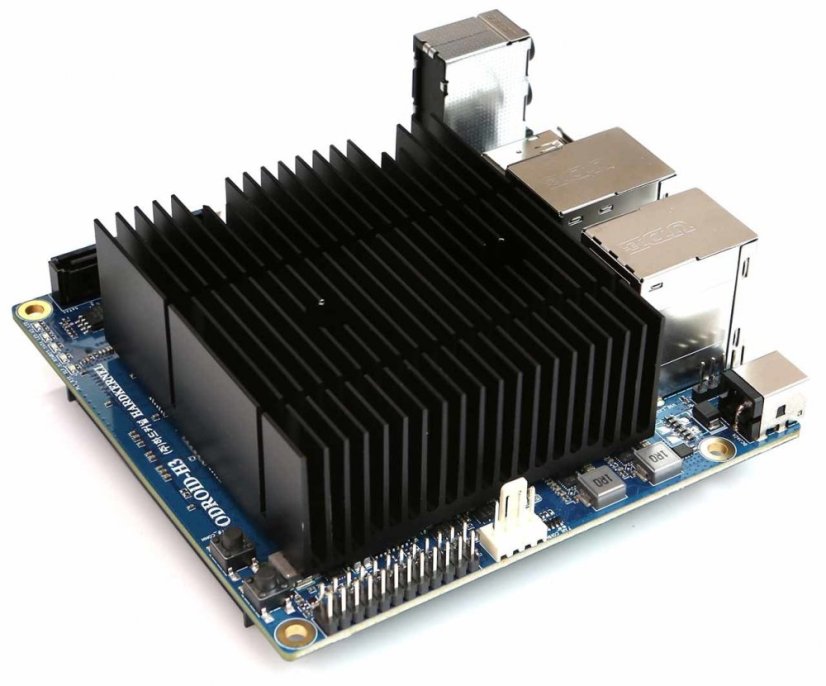
2 x USB 2.0 Host ports 1 x Peripheral Expansion Header (24-pin, 2.54mm pitch) – 1 x DC 5V, 1 x DC 3.3V, 5 x GND – 1 x UART (TXD/RXD/RTS/CTS) – 2 x I2C (SCL/SDA) – 1 x External Power Button – HDMI CEC, 5VA+ – Three USB 2.0 ports – All 3.3V I/O signal levels |
| Additional Features | Passive cooler
BIOS Backup Battery – Maintains system time and BIOS settings Power button Reset button System LED indicators: – Red (PWR) – Stable light when DC power is supplied – Blue (left, SLEEP) – turns off only when the system enters sleep mode – Blue (right, PMIC) – lights up only when the main power lines are operational – Amber (SATA) – blinks when transferring SATA data – Green (NVMe) – blinks when transferring NVMe data Connector for active cooling fan (12V 4-pin, PWM input + TACHO output) – Active cooling fan is optional – Connector (4-pin, 2.54mm pitch) |
| Power | DC jack: outer diameter 5.5mm (negative), inner diameter 2.1mm (positive)
DC 14V ~ 20V (up to 60W) – Recommended power adapter DC 15V/4A, if not using two 3.5" HDD – DC 19V/7A power adapter is recommended if using two 3.5” HDD simultaneously Power Consumption: – IDLE: ≃1..9W – CPUs Stress: ≃15W – CPU+GPU Stress: ≃18W – Off: ≃0.25W – Sleep: ≃0.6W |
| Form Factor | 110mm x 110mm x 47mm approximately |
Installation
https://wiki.odroid.com/odroid-h3/start#installation
WIKI
https://wiki.odroid.com/odroid-h3/start
Introduction
https://dn.odroid.com/ODROID-H2/H3_pics/H3_H3+_Introduction.pdf


 Austria
 Belgium
 Bulgaria
 Croatia
 Denmark
 Estonia
 Finland
 France
 Greece
 Hungary
 Ireland
 Italy
 Latvia
 Lithuania
 Netherlands
 Poland
 Portugal
 Romania
 Slovenia
 Spain
 Sweden
